
An interview with The Lodge’s Build Team

What would you say to people who don’t feel smart enough for an escape room?
 Gabe: Trust your gut. It’s magic.
Amy: I would say it’s really common for people to equate puzzle proficiency and escape room proficiency with intelligence, and that’s just not borne out with watching people do escape rooms. You really get better at escape rooms by doing escape rooms. The number one thing to do is to just talk out loud and think out loud. It really has nothing to do with being too smart or not smart enough or anything like that. It’s more about your ability to think magically, think critically, and communicate with people.
Relatedly, we get asked a lot like, “What’s the hardest room?” And that’s sort of like asking, “What’s the hardest subject in school?” There are a lot of people who would say math, but a lot of people who would say English or something else. Everybody has different strengths, so a puzzle that’s hard for one person might be really easy and obvious for someone else. It’s a lot more idiosyncratic than just smart people are good at things and dumb people are bad at things.
Kyler: And I guess additional to that, everybody is going to bring something different to an escape room because everybody thinks differently. And so, if you think, “Oh, I’m not smart enough to do this,” or like, “Oh, I’m terrible at math,” or something like that, nearly all of the time, when we watch a room, we see everybody contributes in some way. And the way that they contribute usually leans towards the things that they are best at. Somebody is going to be the best at finding everything in the room. Somebody wants to sit down and do the really crunchy math puzzle in the room. And so, just because you don’t think you’re good enough at everything, come in and play towards your strengths — you’re going to find some way to contribute. And if it’s a well-designed escape room, it’s not all going to be just one thing.
What tip would you give to people doing an escape room?
 Gabe: Thinking out loud, because it also helps the game master know where you’re at.
Amy: People don’t like when they’re given hints that spoil things, or hints that help too much, or hints for things they’ve already done. We watch everything on the cameras and we listen, but there’s usually a lot going on. So if you think out loud and you say, “Okay, we’re stuck here. We did this, but it didn’t do anything” that helps give the game master better information about how to give players subtle nudges that are helpful without being intrusive. Thinking out loud is just always helpful. We found that the times where we’ve prompted people to think out loud, they often end up not needing a hint because when you’re going through what you’ve learned and what you haven’t learned, it sometimes sparks things for your teammates or for yourself and makes you realize that you might already have an idea of what to do next.
When you find something, hold it up. One thing that some groups run into is just not communicating to each other. Everybody gets in and they’re very excited and they’re all doing different things, and sometimes people don’t do a great job of telling each other what they’re finding. When Kyler was talking about different strengths for different people, communication is a very good strength for some people to have. So often there is a mom who is “not good at puzzles” who just gets everyone to listen to each other and is like, “Oh, you found a key. Didn’t you say earlier that you found a lock?” Like even if that person isn’t solving any puzzles, they’re the only reason any puzzles get solved. So working together on things is kind of the biggest hint there.
Kyler: Yeah, you can be off on your own in a corner and you’ve figured out the solution for this puzzle, but if you don’t know what to do with that information, but somebody else might, you know, you may as well have not solved it.
Amy: One of my favorite moments ever watching a room was still from the very first room we did when we were early play testing. This was the Apartment over at what became Legend of Lyndale House. The apartment had a big living room and then this kind of long hallway, and then the bedroom. There’s a puzzle in the living room that opens the lock on the bedroom door. And my brother, who’s a very quiet, shy person, figured out how to open the lock on the bedroom door. And he went and he opened the lock on the bedroom door, and then he went back to the living room and said, “Guys, I opened the bedroom,” and no one heard him. So he just didn’t tell them again, and kept kind of just exploring the living room with everybody else, and so he opened the door to the bedroom but didn’t even go in and no one knew. And so the bedroom was just open for a long time with no one going in it. That was what, 11 years ago at this point, and I still remember it.
Kyler: Communication is a superpower in escape rooms.
Amy: Yeah, it absolutely— communication and listening is a superpower.
What are common misconceptions about escape rooms?
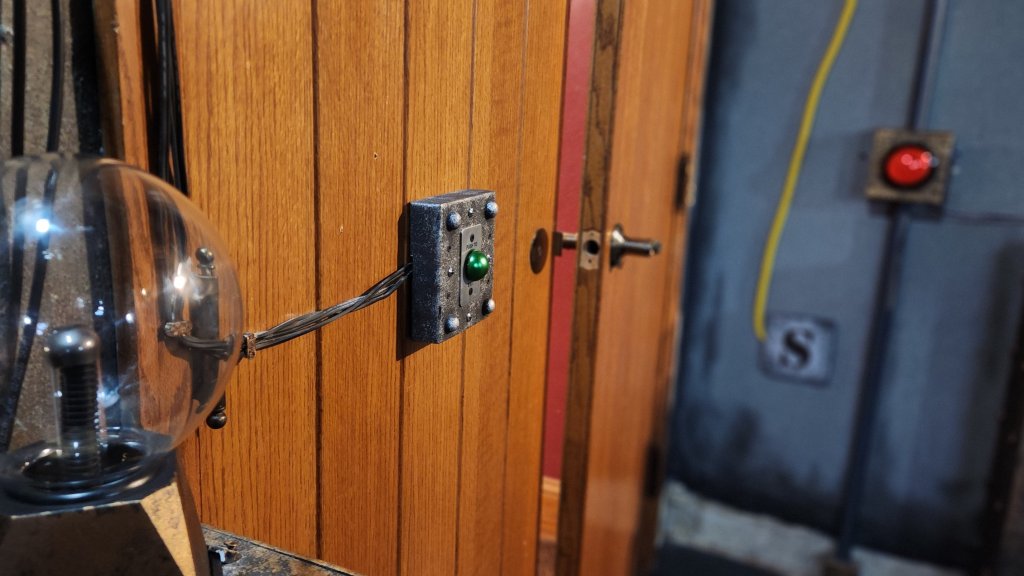
Gabe: A really common misconception is that they’re all scary. At least an early misconception. They’re all scary, you’re locked in a room, it’s going to be themed like Saw, and you’re trapped and you’re trying to escape, which is just almost never true. Certainly never true here. We never lock people in the rooms. You have a mission or a story that you’re pursuing. It’s more active. We can’t, obviously, legally lock people in rooms because of fire code. So knowing that you’re never going to be locked in is kind of putting a lot on our customers to pretend you’re locked in. “Here’s your button to escape, but also don’t press it, ’cause you’re locked in for sure.” That’s kind of a lot. So, we have found it’s much more motivating and exciting to give players a mission they’re trying to accomplish, and they’re not locked in the room at all.
Kyler: These are people that want to be in the room, they’re not there against their will.
Amy: Then another common misconception is just having to do with the difficulty, that they’re— they’re very hard, that you’re locked in, that it’s scary. A lot of early escape rooms we call Generation 1 rooms, which were a lot of paper puzzles, a lot of physical locks, there’s a key under, you know, a rug, you have to just find it. If you don’t find it, tough luck and there’s no clues to it. They were really fun for their time. As an industry, we’ve kind of moved past it, but there’s a certain contingent of customers who played that style of room early on and then never played an escape room again, so they think that’s what rooms still are. When at this point, the best escape rooms are really more collaborative, theatrical entertainment things than finding a series of keys in a room.
Something that’s been helpful in a lot of ways is a lot of movies and TV shows have an escape room episode. And a lot of times those escape room episodes, even if it’s not a great room, it kind of does a good job of showing how escape rooms work. There’s a Portlandia one, there’s one in Crazy Ex-Girlfriend, there’s a bunch of them. And that actually has helped in some ways’ because it’s made it clear that the rooms don’t work like they used to. Escape rooms are closer to immersive theater, immersive collaborative storytelling, than they are to sitting down, doing anagrams, doing a crossword, doing a sudoku. None of that should be in an escape room.